Her Daughter's Wedding Was Six Weeks Away. She Tried One More Thing. She Is Glad She Did.
A mother of the bride in North Carolina, a Korean dermatologist in Seoul, and what a cream designed to work at the source rather than the surface can do in the small window most women have before an event that matters.
After my last piece about tired-looking skin in women over sixty, I started receiving a different kind of letter.
The first one came from a woman in Connecticut whose granddaughter was getting married in October. She wrote that the article had explained something she had felt for years, but she did not have a year. She had three months.
She wanted to know whether there was anything she could do in the time she had.
I sat with the letter for a week before I knew what to say.
In the months since, the letter has become a category. A mother whose daughter is getting married in May. A grandmother whose grandson is getting married in June. A woman in Vermont whose family reunion is in August and who has been the one missing from the last three of these. Each woman has a date. Each woman has fewer weeks than she would like. Each woman has the same underlying question, asked in slightly different ways.
If something is going to work, will it work in time.
This piece is about one of those women. Her name is Frances Holloway. She is seventy-two. Her daughter Claire was getting married in six weeks when she wrote to me. I drove down to see her in March. What follows is what she told me, what I learned from the dermatologist she eventually ordered from, and what happened on the second Saturday in May.
A photograph from the engagement party
Frances lives outside Asheville in a low stone farmhouse her husband Tom restored in the mid-eighties. She retired three years ago after twenty-eight years as the principal of the elementary school in the next town over. She has two children. James, the older, lives in Charlotte with two small children of his own. Claire is forty-one and is, in Frances's careful phrasing, getting married for the right reasons this time.
Frances wrote to me a week after the engagement party.
The party had been at the farmhouse, in February, with the trees still bare and the light low and clean. The photographer Claire had hired for the wedding had come to test the property. He had taken candid photographs throughout the afternoon. Two weeks later he sent Claire a folder of preview shots, and Claire forwarded a few to her mother.
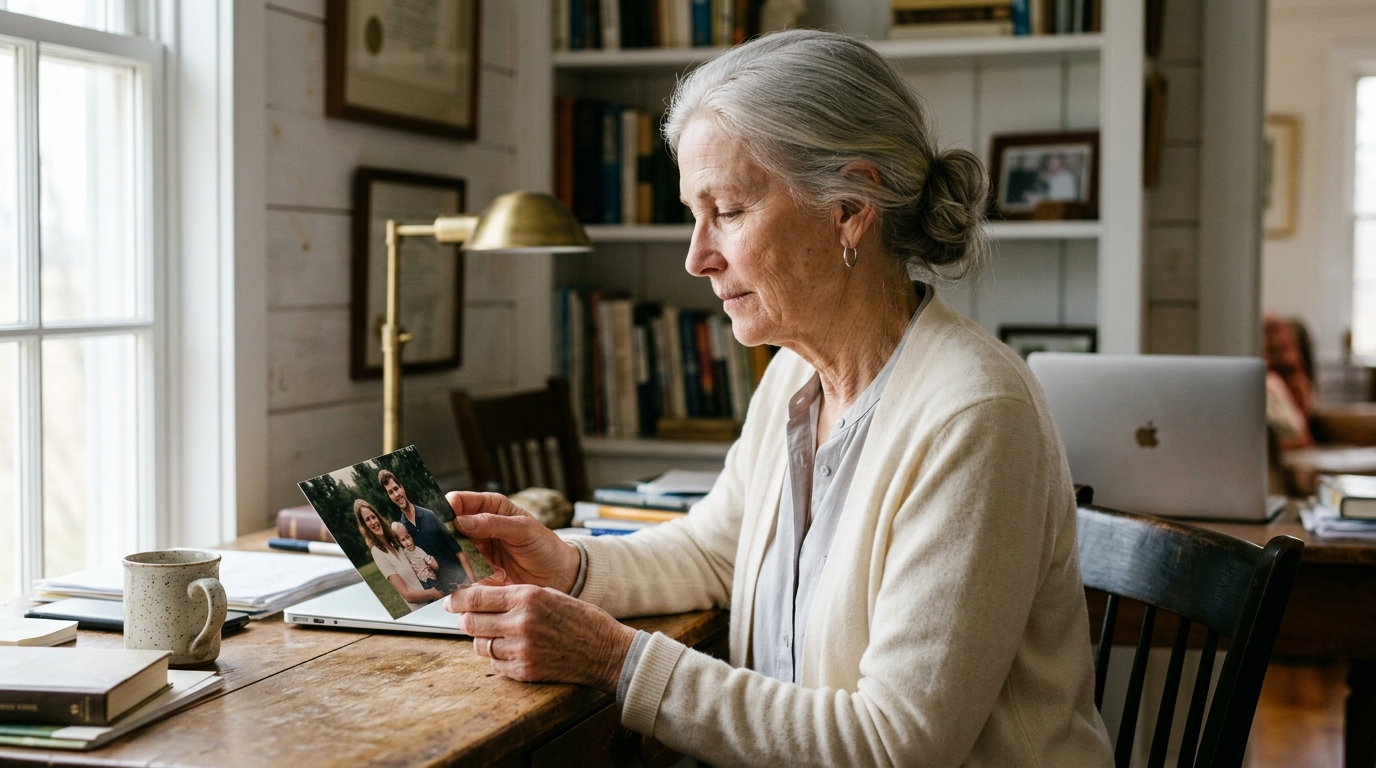
Frances opened one on her laptop, on a Tuesday morning, alone, with her second cup of coffee. In the photograph she was standing next to Claire near the kitchen window. Claire was laughing. Frances was looking at her daughter with an expression Frances did not remember making. The light caught the right side of her face.
She wrote to me that she did not recognize the woman in the photograph. The dress was hers. The earrings were hers. The room was hers. The face, she said, was a face she had not been ready to see.
She was not distressed when she wrote this. She was specific. Frances is a careful woman, and her letter was a careful description of a specific moment.
She said the wedding was in six weeks. She said she had no interest in not being in the photographs. She said she had spent forty years being the person who took the photographs, and now she was going to be in them. She said she wanted to know whether anything she could try in six weeks would make the woman in those photographs look more like the woman she felt herself to be.
I called her that evening.
What she had tried, and what she had not had time to try
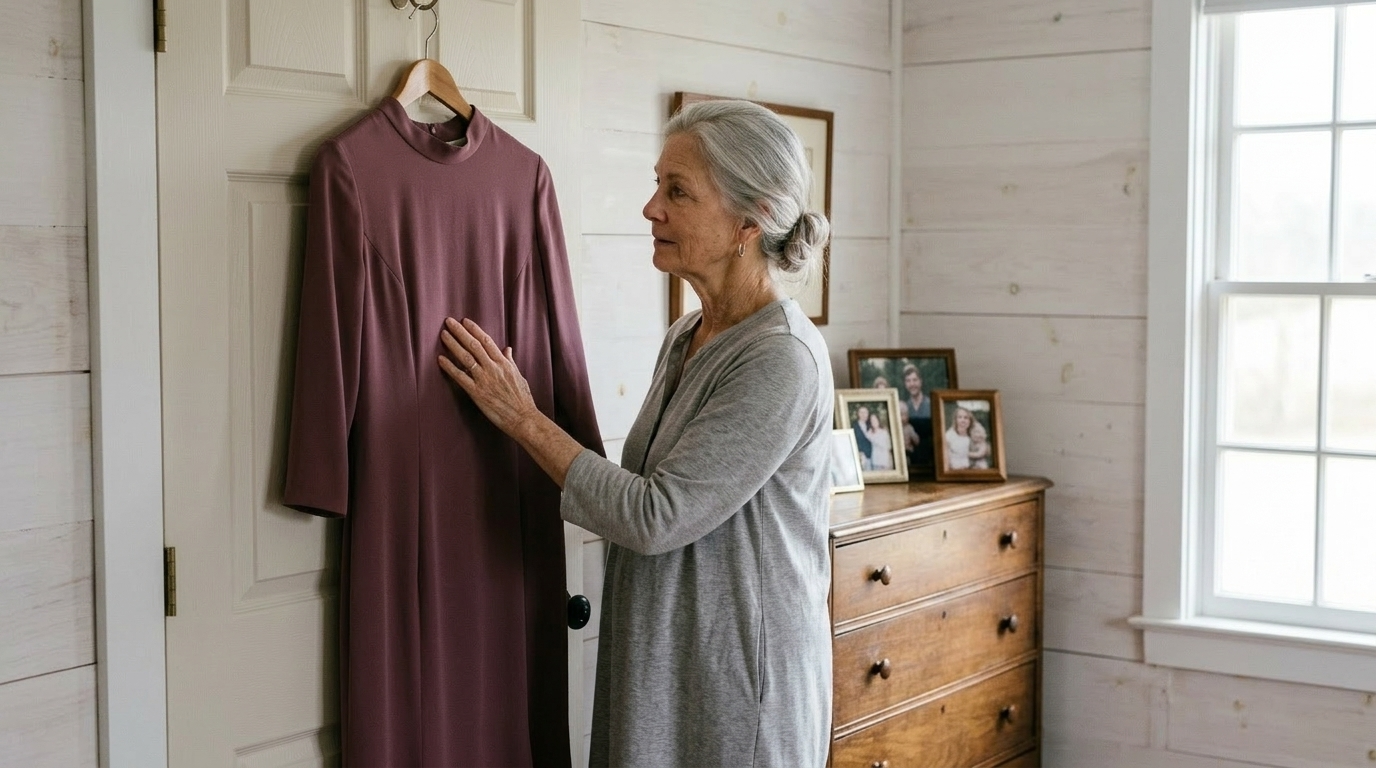
When I got to Asheville in early March, Frances poured coffee and took me into the small sitting room at the back of the house. The mother-of-the-bride dress was hanging in a garment bag on the back of the door. It was a deep mauve, simple, with a high neckline. She had chosen it in January.
We talked about her skin for an hour.
Frances had been using the same drugstore moisturizer for twenty-two years. She had tried a vitamin C serum a friend had recommended in her late sixties and stopped after a month because she had not noticed anything. She had bought a department-store cream at a counter at a mall in Charlotte during one of her trips to see James and the grandchildren, used it for the better part of a year, and concluded that the only thing it had done was deplete her bank account by about three hundred and twenty dollars. She had not tried retinol. A friend who had tried retinol had told her about the redness that followed, and Frances had decided she did not have the patience.
She was, as she put it, late to the question. Most of her friends had been having these conversations for fifteen years. Frances had spent those fifteen years running a school and helping Tom restore the house, and her skin had been somewhere on a list she had not got around to.
She had four reasonable weeks of skincare experimentation before her final dress fitting and a hair-and-makeup trial. After that the calendar was full. Whatever she tried, she needed to start within a week.
I asked her what would make her order something.
She said she needed to understand why it was supposed to work. She had been in the business of explaining things to children for twenty-eight years. She knew the difference between an explanation that held and an explanation that came apart when a curious eight-year-old asked a follow-up question. Most of what she had read about skincare came apart at the second question.
I told her about a Korean dermatologist I had been speaking with for an earlier piece.
The question I brought to Dr. Cho
I had spoken with Dr. Suhyen Cho twice the previous month. She had been generous with her time and clear in her language. I wrote to her again and asked a different question this time.
If a woman in her seventies came to your clinic in Seoul with an event six weeks away, I wrote, what would you say to her.
Dr. Cho is a Korean dermatologist who founded a small brand called Osenra after twenty-five years in clinical practice at Spring Light Dermatology Clinic. She has spent most of her career in the same neighborhood in southern Seoul. The women who come to her clinic include many older women with the same question Frances was asking, in a slightly different register. Korean weddings happen on a schedule, and Korean mothers do not want to look on that schedule the way they look on an ordinary Tuesday.
She wrote back in three paragraphs.
She said the question I was asking her was the question Korean dermatology had been built around. Korean practice, she said, did not treat skin as something to be transformed. It treated skin as a tissue with biology. The biology, she said, responds to inputs the way any tissue does. There is an early phase and a later phase. The early phase shows up in the first month. The later phase takes longer.

The early phase, she said, is mostly about three things. Barrier repair, which determines how the skin holds water and how it reflects light. Inflammation, which is the cause of most of what reads as dullness and unevenness in older skin. And the first signs of cellular renewal, which begin to show themselves at the surface within two to four weeks of consistent application.
She said that what most older women describe as their skin looking better at the thirty-day mark is not transformation. It is repair. The deeper structural work, the kind that addresses fine lines and longer-term firmness changes, takes a full cycle of skin turnover, which in women in their seventies is closer to two or three months than it is to one.
She was clear about what could and could not happen in six weeks. She said the cream she had formulated was not going to remove fine lines in that window. It was not going to lift the structure of the face. What it was going to do, in the women who responded to it, was let the skin sit differently against the light. Water-holding capacity would improve. The grey quality some older women describe would soften. The skin would look less drawn. Makeup would settle better. The face in a photograph taken in good light would look more like the face the woman felt herself to be.
She said this would be enough for many women with an event approaching, and not enough for others. She said she would tell Frances exactly that and let Frances decide.
I forwarded the letter to Frances.
What Frances decided
Frances read the letter twice. Then she read it again the next morning.
She wrote back that the explanation had held under her own follow-up questions. She had a question about what TECA was and how it differed from the centella asiatica she had read about in two of the products she had not bought. I sent her what Dr. Cho had told me in our earlier conversations. Centella asiatica is a plant used in Korean herbal medicine for centuries, primarily for wound healing. TECA is its standardized pharmaceutical extract, with the three active compounds, asiaticoside, asiatic acid, and madecassic acid, concentrated to consistent levels. The compounds have appeared in dermatological research for decades, including in post-surgical scar treatment. Most Western products that mention centella asiatica use the raw plant material at concentrations far below what the research supports. Dr. Cho's formulation uses TECA at the concentration Korean practitioners use clinically.
Frances said the explanation was the first one she had received about a skincare product that did not come apart at the second question.
She said she would order one tube.
The product is called TECA Skin Repair Cream. It arrived in a small box on a Thursday in mid-March. The packaging was plain. The cream was fragrance-free. The texture was smooth and absorbed quickly. Frances put it on her face that night, after she washed it, and again the next morning, before her foundation.
She had four weeks and four days before the final dress fitting.
Week two
Frances wrote to me ten days in.
The change, she said, was small enough that she was not sure she could trust it. The skin around her eyes seemed to hold light differently. Not the lines. The quality of the skin in the spaces between the lines.
She said the morning routine had become slightly less of a struggle. The foundation she had been wearing for two years was sitting on her face instead of disappearing into the dry texture beneath it. She had not changed the foundation.
She said she would keep going and would not write again until she had something more definite to report.
Week four, in her sister's words
The next letter was longer.
Frances's sister Margaret had driven up from Greenville on a Saturday in late March to help finalize the seating chart. They had spent the day in the kitchen with a map of round tables and a list of guests. In the late afternoon Margaret had set down her coffee and looked at Frances and said, Frannie, you look really well, what is going on.
Frances said it was nothing she could explain. Margaret said Frances's skin looked, she searched for the word, settled. Frances wrote to me that night and used the same word in her letter. Her skin looked settled. The drawn quality she had seen in the engagement-party photograph was less drawn. She did not look transformed. She looked, she said, like she had been sleeping better. She had not been sleeping better. The wedding was in two weeks and ten days and she was not sleeping particularly well.
This was thirty-one days after she had started using the cream.
Week five, the final fitting
The final dress fitting was on a Wednesday morning at a small bridal shop in downtown Asheville. Frances sent me a photograph from the dressing room. She was looking at herself in the three-way mirror with the mauve dress on. Her hair was loose. She was not smiling. She was looking at her own face the way a woman looks at her own face when she is trying to assess something.
She wrote underneath the photograph: I do not look transformed. I look like a woman who is going to be at her daughter's wedding in a week and a half.
She said the photograph of herself she had seen in February, the one from the engagement party, was not the photograph she expected from May. She did not say this with certainty. She said it with the careful provisional language she used about everything.
I drove back down to Asheville the following weekend.
The second Saturday in May
The wedding was outside, on the lawn behind the farmhouse, under an old white oak that Tom had pruned for the occasion. The forecast had said rain. It did not rain. The sky stayed the color of an old photograph until late in the afternoon, when the light tilted low and gold across the field behind the house.
I was there as a guest by then. Frances had asked. I had said yes.
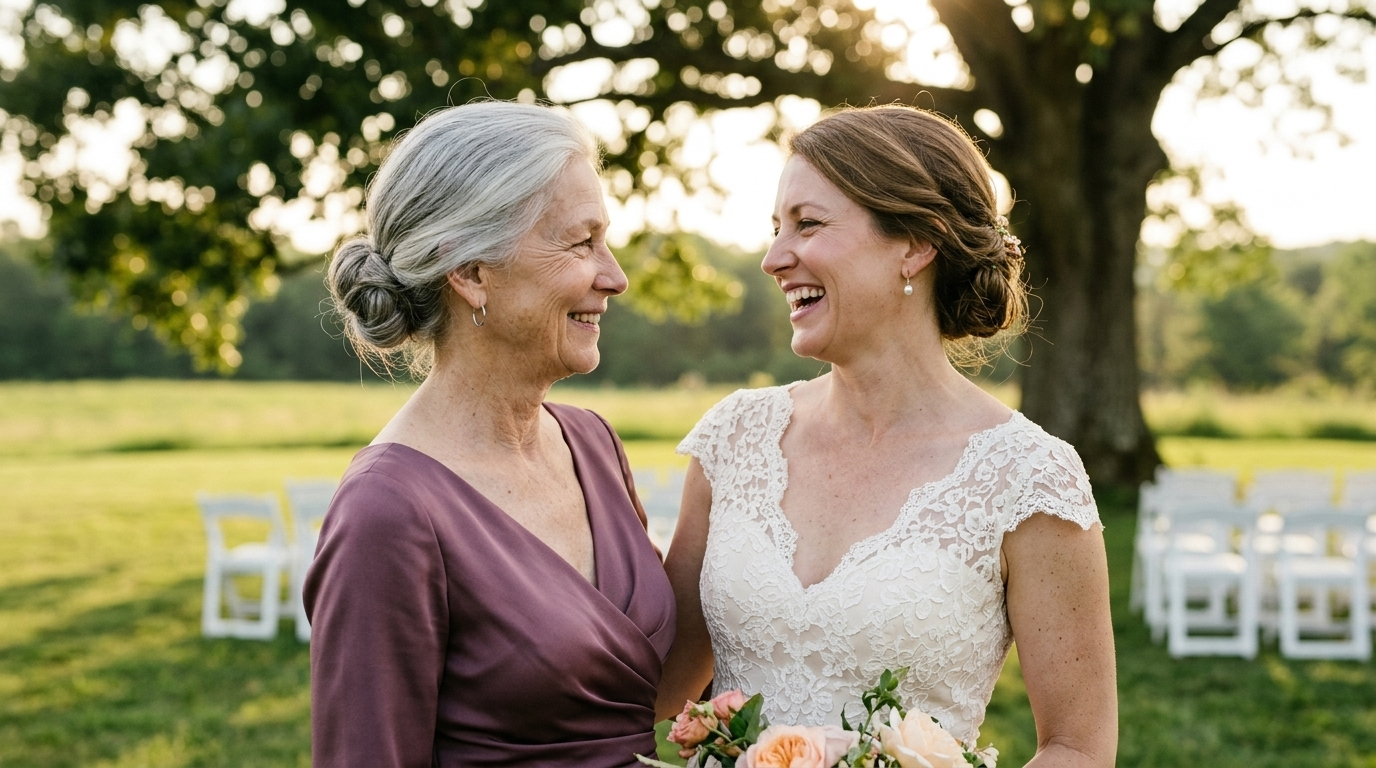
Frances walked Claire down a short gravel path from the side door of the house to a square of mown grass under the tree. She was wearing the deep mauve dress. Her hair was up. The photographer was working from the far side of the gathering, the way good wedding photographers do, present and invisible.
I watched Frances during the ceremony from where I was standing near the edge of the chairs. She looked like a woman in her seventies who was at her daughter's wedding. She did not look like a woman who had been ten years younger. She did not look like a different person. She looked like herself, present, dignified, and visible in a way she had been telling me for two months she had stopped feeling.
When the photographer asked her to stand with Claire for the family portrait in the late afternoon, the light caught the right side of her face. It was the same angle as the engagement-party photograph from February. I was close enough to see it.
The face was different. Not younger. The same face. Settled. Less drawn. The light sat against it instead of being absorbed into the dryness of it.
I noticed this. I did not say it. Frances did not need me to say it. She was looking at her daughter.
Three weeks later, on the couch in the sitting room
Frances wrote to me in early June. The wedding photographer had delivered the album. She and Tom had gone through it on a Sunday afternoon.
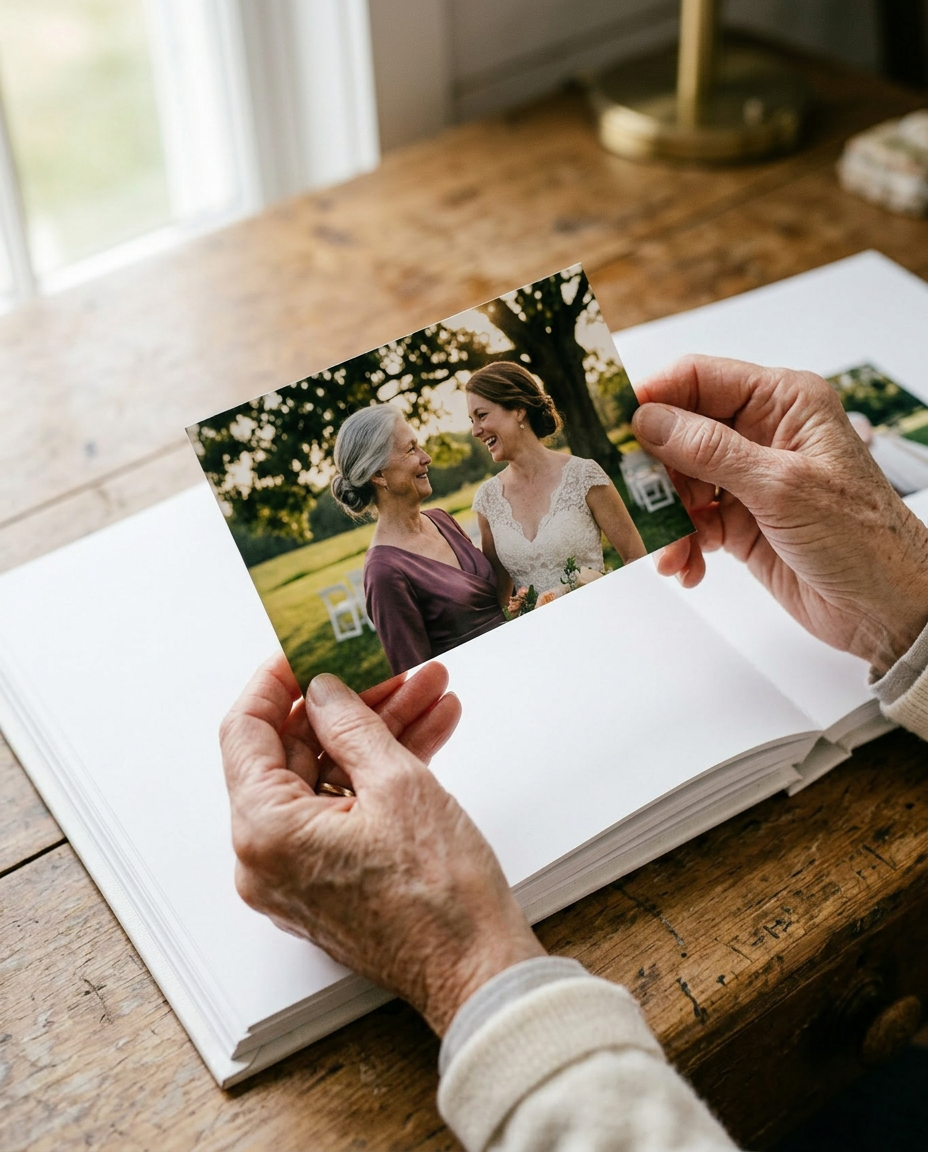
Then James and his family had driven up from Charlotte for a weekend in mid-June. Frances's granddaughter Lily, who is four, had asked to look at the album. They sat on the couch in the sitting room and turned the pages together.
Lily had stopped on the photograph from the family portrait, the one with the light tilting low across the field.
Lily had pointed at Frances and said, Grandma, you are pretty in this picture.
Frances wrote to me that night. She said she had been ready for many of the things the wedding had brought her. She had not been ready for the moment in which she understood that the photograph in the album was the photograph her grandchildren would look at for the rest of their lives. The photograph of her in Claire's wedding album was the photograph that would exist when she was no longer here to be looked at.
She said she was glad it was the face it was.
What I am prepared to say about this
Frances's timeline is the timeline she described to me. I have not embellished it. I am telling you what she told me, what I observed when I was with her, and what was visible to me in the photographs from the day.
What is true and what is not true about the cream Frances used can be stated plainly.
It is not true that this cream will make a woman in her seventies look forty. It is not true that it will lift the structure of an aging face, or that it will erase fine lines in six weeks, or that any cream will reverse what bone and fat redistribution have done over a lifetime.
What is true is that the mechanism Dr. Cho described is supported by decades of dermatological literature. The compound she names is real, standardized, and not new. The formulation is done in Seoul by a Korean dermatologist who has practiced for twenty-five years and who can be found and verified. The cream produces, in the women who respond to it, an early-phase change that is visible in the first month. The change is not transformation. It is the skin sitting differently against light. The face in a photograph looking more like the face the woman feels herself to be.
For a woman with an event approaching, that is sometimes enough. For some women, it is the thing they wanted. For others it is not enough and they will write to the brand for their refund.
The brand carries a ninety-day money-back guarantee that does not require the buyer to return the product or explain herself. The window covers the event for almost every woman who orders within two months of her date. The risk is, in practical terms, the cost of trying.
I have learned to be careful about the words I use when I write about skincare. The cream Frances used is one of the few products in this category I have written about in fourteen years that has held up under the questions an intelligent woman asks before she orders something. That is what I am willing to say.
If you are reading this with a date in mind
If you are reading this with a wedding or a family gathering or a milestone on your own calendar, the next page is worth reading. Dr. Cho's clinical background, the formulation details, the application instructions, and the 90-day guarantee are explained there. Frances's timeline is one of many. The mechanism behind it is the same.
See How TECA Skin Repair Cream Works →I will follow up with Frances at the six-month mark. If anything changes that the reader should know about, I will write about it.
This article contains sponsored content. The author received compensation for this piece. Individual results may vary. Statements have not been evaluated by the Food and Drug Administration and are not intended to diagnose, treat, cure, or prevent any disease.
Carolyn Hartwell is a health and beauty writer with fourteen years of experience covering skin health for women over fifty.
© 2026 Osenra. All rights reserved. For brand contact and guarantee details, see the next page.